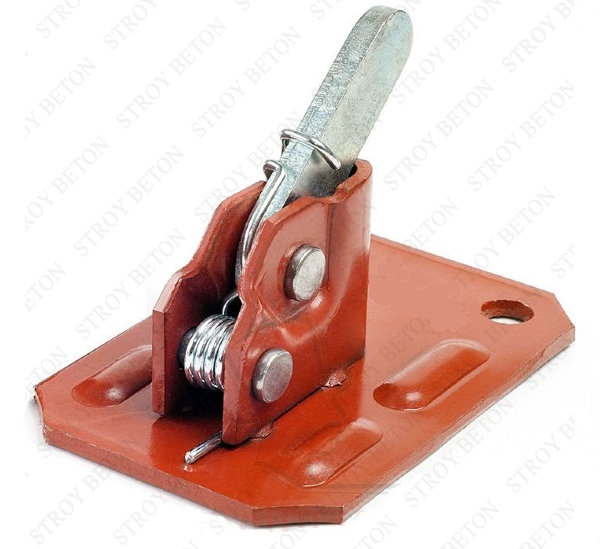
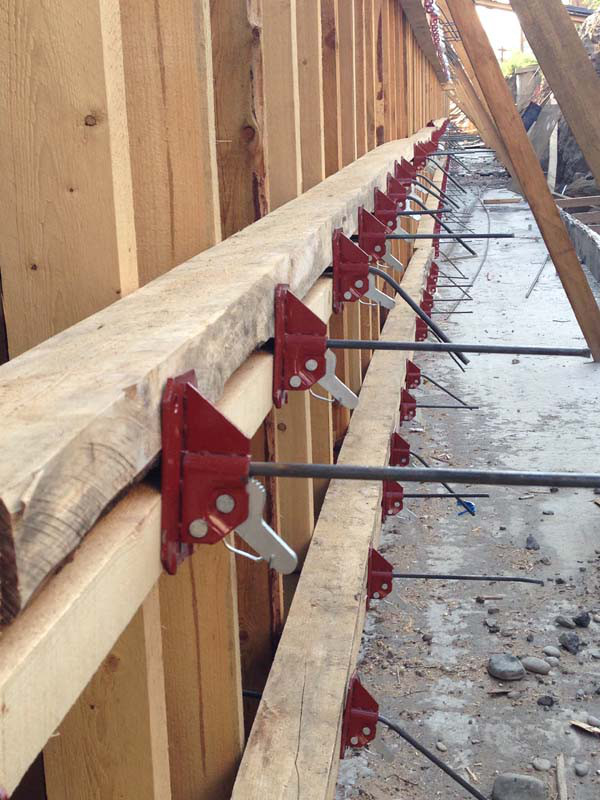
A spring clamp (clip) is used to fix formwork panels without the use of tie rods.
It is mounted on wire or rebar with a diameter of 6 to 10 mm and tightened using a special wrench.
The clamp can be used with or without panel formwork when constructing foundations, tunnel shafts, walls, columns, and other monolithic concrete structures.
The clamp is made of steel.
Its toothed locking tongue is hardened in a nitrogen environment, which keeps the teeth sharp and durable for a long period of use.
This reinforcement clamp offers several advantages compared to other models:
-
Hardened disc-shaped tongue with a width of 6 mm;
-
Fastening mechanism equipped with a high-strength, tight spring;
-
All components are galvanized, and the body is painted, providing extended service life on construction sites;
-
Large support base, with a total weight of 360 grams.
SPRING CLAMP – THE MOST COST-EFFECTIVE ALTERNATIVE TO A NUT AND TIE ROD!
Spring clamps are installed on only one side of the monolithic frame formwork.
On the opposite side of the rebar, a stopper — a short piece of rebar — is welded.
As a result, one end of the bar looks like the letter “T”, while the other end remains free.
This free end is inserted into the formwork hole, and a spring clamp is attached to it, ensuring the stability and fixation of the structure — similar to a nut and tie rod system.
When using clamps, the rebar does not need to be removed — it is enough to cut off the protruding end, and the cut area is sealed with mastic.
The clamps can withstand multiple concreting cycles without losing their functionality.
The elimination of costly components such as tie rods, nuts, and additional consumables (PVC tubes and cones), along with the ease and speed of installation, makes this solution simple, efficient, and economical for producing strip foundations, monolithic walls and columns, and concrete belts.